Before You Listen
Episode Setup
- Topic in one line: the downstream consequences of the physiologic decline mapped in Part 1, including treating the osteoporotic skeleton, the aging lung and age-adjusted oxygenation, pharmacokinetics beyond the kidney, distinguishing normal cognitive aging from dementia, sleep architecture and motor-learning consolidation, and falls plus the geriatric syndromes of frailty and delirium.
- Prerequisites: Part 1 of BASIC-09 (sarcopenia with selective type 2 fast-twitch fiber loss, postmenopausal trabecular-first bone loss, isolated systolic hypertension, baroreceptor dysfunction, chronotropic incompetence, the hidden estimated glomerular filtration rate (eGFR) of a sarcopenic patient); basic pharmacology vocabulary (volume of distribution, protein binding, phase 1 and phase 2 hepatic metabolism).
- Runtime: 45 minutes.
Vignette. A 78-year-old woman is admitted to inpatient rehabilitation three days after open reduction and internal fixation of a right intertrochanteric hip fragility fracture. Her dual-energy X-ray absorptiometry (DEXA) scan showed a T-score of -3.2 at the lumbar spine. On admission she is started on alendronate 70 mg weekly, calcium 1,200 mg daily, and vitamin D 800 international units (IU) daily. On rehabilitation day 4 the night-shift resident notes she has been awake since 3 AM and adds zolpidem 5 mg at bedtime for “sleep hygiene.” By morning the patient is somnolent and inattentive, with alertness that fluctuates through the day; she confidently insists she had breakfast with her late husband, and on therapy fails the timed up and go (TUG) at 17 seconds. Her serum 25-hydroxyvitamin D (25-OHD) returns at 22 ng/mL.
Address four clinical issues in this case: (1) what specific administration rule alendronate requires and the risk if it is violated, (2) which physiologic 25-OHD target she has not yet reached and how the osteoporosis target differs from a proven fall-prevention threshold, (3) what acute cognitive syndrome she now has, how it differs from dementia, and which validated bedside instrument confirms it, and (4) which Beers-listed drug class contributed to her presentation.
(Answer at the end of this chapter)
Section 1: Treating the Osteoporotic Skeleton
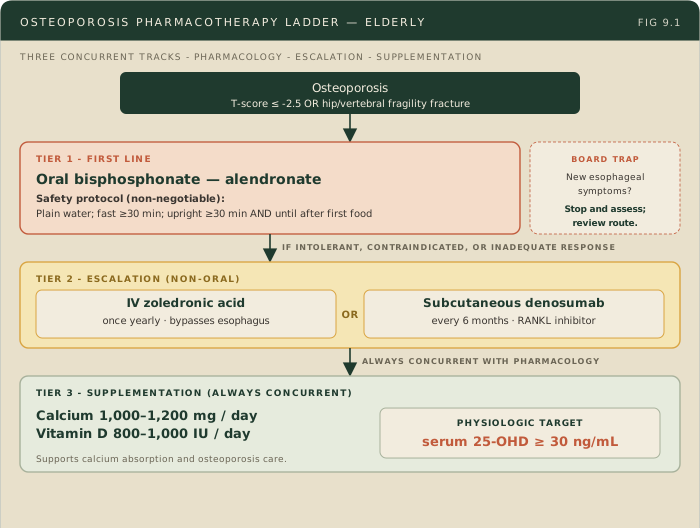
Bottom line: osteoporosis is treated on three concurrent tracks: pharmacologic inhibition of resorption, supplementation, and a physiologic target for vitamin D. First line is an oral bisphosphonate (alendronate), taken with plain water, fasting for at least 30 minutes, and upright for at least 30 minutes and until after first food. Escalation is intravenous zoledronic acid yearly or subcutaneous denosumab every 6 months. Calcium 1,000-1,200 mg/day plus vitamin D 800-1,000 IU/day, target serum 25-OHD ≥ 30 ng/mL, an osteoporosis-context target, not a proven universal fall-prevention threshold.
Part 1 ended with the vignette patient at a DEXA T-score of -3.0 with an intertrochanteric fragility fracture. The diagnostic logic is unchanged. Osteopenia is a T-score between -1.0 and -2.5; osteoporosis is -2.5 or lower. But a low-trauma hip or vertebral fracture establishes osteoporosis and supports treatment regardless of the T-score. A proximal humerus, pelvic or distal forearm fragility fracture establishes it when the T-score is between -1.0 and -2.5.
An oral bisphosphonate, such as alendronate, is a common first-line osteoporosis treatment. Take it on arising with 6–8 ounces of plain water, at least 30 minutes before the first food, drink or other medication. Remain upright for at least 30 minutes and until after the first food of the day. These steps support absorption and reduce esophageal injury risk. Esophageal emptying disorders such as stricture or achalasia, inability to remain upright, and hypocalcemia are contraindications; vitamin D deficiency is treated before the first dose; reflux alone is not an absolute contraindication. New dysphagia, painful swallowing, retrosternal pain or worsening heartburn requires stopping the drug and seeking evaluation.
Pharmacology only halts withdrawals; it does not deliver raw materials. Secondary prevention runs in parallel: calcium 1,000-1,200 mg/day (diet plus supplements as needed) and vitamin D 800-1,000 IU/day, tied to a serum 25-hydroxyvitamin D (25-OHD) target of at least 30 ng/mL in established osteoporosis. The target matters because intestinal calcium absorption depends on vitamin D; without it, supplemental calcium is partially excreted unabsorbed. Reaching the target does not by itself guarantee improved balance or fewer falls, so treat deficiency and support osteoporosis care without prescribing vitamin D as a fall-prevention drug.
When oral therapy is contraindicated or not tolerated, switch to IV zoledronic acid yearly or subcutaneous denosumab every 6 months after reviewing renal function, calcium/vitamin D status and individual risks. A new fracture or bone loss during treatment warrants assessment of adherence and secondary causes before declaring treatment failure. Do not delay or stop denosumab without a plan for subsequent antiresorptive therapy, because its effect reverses after discontinuation.
 ::: {.callout-important}
## High Yield — Osteoporosis Treatment
::: {.callout-important}
## High Yield — Osteoporosis Treatment
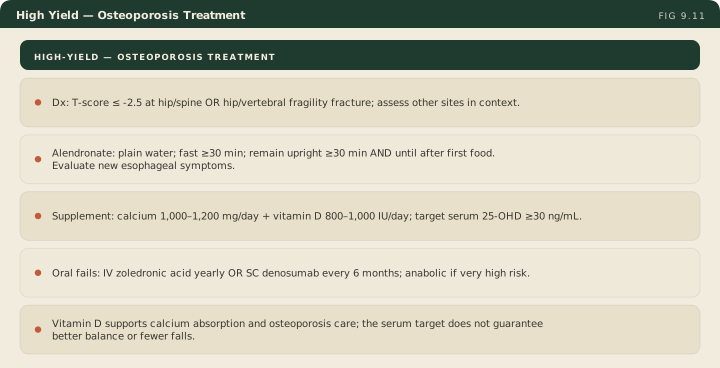
- Diagnosis trigger: T-score ≤ -2.5 at hip or lumbar spine OR low-trauma hip or vertebral fracture regardless of BMD OR proximal humerus, pelvis or distal forearm fragility fracture with T-score between -1.0 and -2.5.
- First line: oral bisphosphonate (alendronate). Plain water, fasting ≥30 minutes, and upright ≥30 minutes and until after first food.
- Supplementation: calcium 1,000-1,200 mg/day, vitamin D 800-1,000 IU/day, target serum 25-OHD ≥ 30 ng/mL.
- Escalation when oral fails (intolerance, contraindication, or inadequate response, meaning a new fracture or continued bone loss on therapy once adherence and secondary causes have been checked; two or more incident fragility fractures on therapy meet the formal definition of treatment failure): IV zoledronic acid yearly OR subcutaneous denosumab every 6 months; at very high fracture risk, an anabolic agent instead.
- Vitamin D is a bone-health factor: it enables intestinal calcium absorption, and the 25-OHD target is an osteoporosis-context target. Fall prevention is its own track (balance training, medication review, vision, environment); the 2018 USPSTF review found no fall-prevention benefit from vitamin D supplementation in community-dwelling older adults not known to be deficient, and the 2022 World Falls Guidelines reserve vitamin D for fall prevention to those at risk of deficiency. :::
Board Trap — The Patient Who Lies Back Down
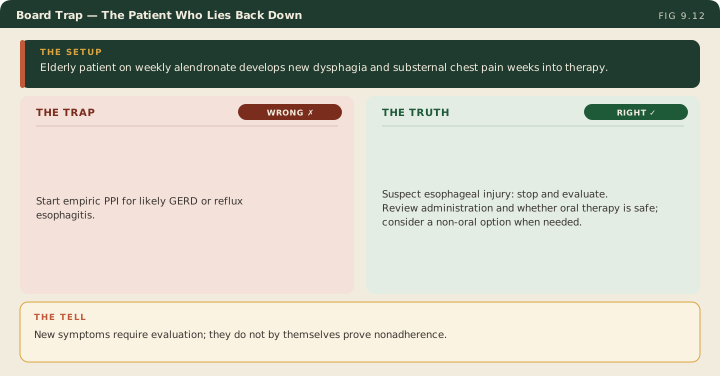
New dysphagia or retrosternal pain while taking alendronate raises concern for esophageal injury. Stop the oral drug and evaluate; symptoms do not prove nonadherence. Review administration technique and whether oral therapy remains suitable. A non-oral option may be appropriate when intolerance or a contraindication prevents safe oral treatment.